
Sohini Roychowdhury
In India, dance has never been merely performance. It is memory made visible, mythology translated into movement, and philosophy carried through the body. Long before proscenium stages and festival circuits, dance lived in temples, monasteries, royal courts, and open courtyards — evolving as an embodied language that conveyed devotion, storytelling, and aesthetics in equal measure. India’s classical dance traditions are not only artistic systems; they are cultural ecosystems shaped by geography, climate, ritual, and the rhythms of nature itself. Each form carries the imprint of the land from which it emerged, drawing deeply from the natural world — its seasons, animals, landscapes, and cosmic cycles.
The philosophical and aesthetic foundation of Indian classical dance lies in the Natya Shastra, the ancient Sanskrit treatise attributed to the sage Bharata Muni, believed to have been composed between 200 BCE and 200 CE. More than a manual of performance, the Natya Shastra presents art as a sacred science — a fifth Veda created to make knowledge accessible through performance. It codified movement, gesture (mudra), expression (abhinaya), stagecraft, music, and dramatic structure, establishing a comprehensive grammar that continues to guide Indian classical dance even today. Central to this text is the concept of rasa, the emotional essence experienced by the audience. The dancer’s purpose, according to Bharata Muni, is not mere display of skill but the evocation of universal emotion — transforming personal expression into shared experience. The natural world itself becomes a reference point, with gestures often drawn from birds, animals, flowers, and celestial phenomena, reinforcing the idea that art mirrors creation.


Bharatanatyam, originating in Tamil Nadu, is among the oldest surviving dance traditions of India. Rooted in temple rituals and once performed by devadasis, its modern revival in the early 20th century is closely associated with figures such as Rukmini Devi Arundale. Legendary exponents like Balasaraswati, Yamini Krishnamurthy, and Alarmel Valli brought emotional depth and technical refinement to the form. Bharatanatyam’s geometry reflects the architecture of South Indian temples — symmetrical, grounded, and precise — but it also mirrors nature’s stability. The deep aramandi stance connects the dancer to the earth, evoking mountains and rooted trees, while sharp lines and rhythmic footwork resemble the measured patterns of rainfall and the cyclical certainty of sunrise and sunset. The dance embodies balance, much like nature’s own equilibrium.
Kathak, from the northern regions of Uttar Pradesh and Rajasthan, evolved from itinerant storytellers known as kathakars, later shaped by Mughal court aesthetics. Legendary dancers such as Birju Maharaj, Sitara Devi, and Kumudini Lakhia expanded its expressive vocabulary. Kathak’s defining spins evoke the whirl of wind and the turning of seasons, while its intricate footwork echoes the sound of rain striking the earth. The improvisational dialogue between dancer and musician resembles natural rhythm itself — unpredictable yet patterned, like monsoon clouds gathering and dispersing. Kathak’s fluidity reflects the open plains of North India, where movement flows without constraint.

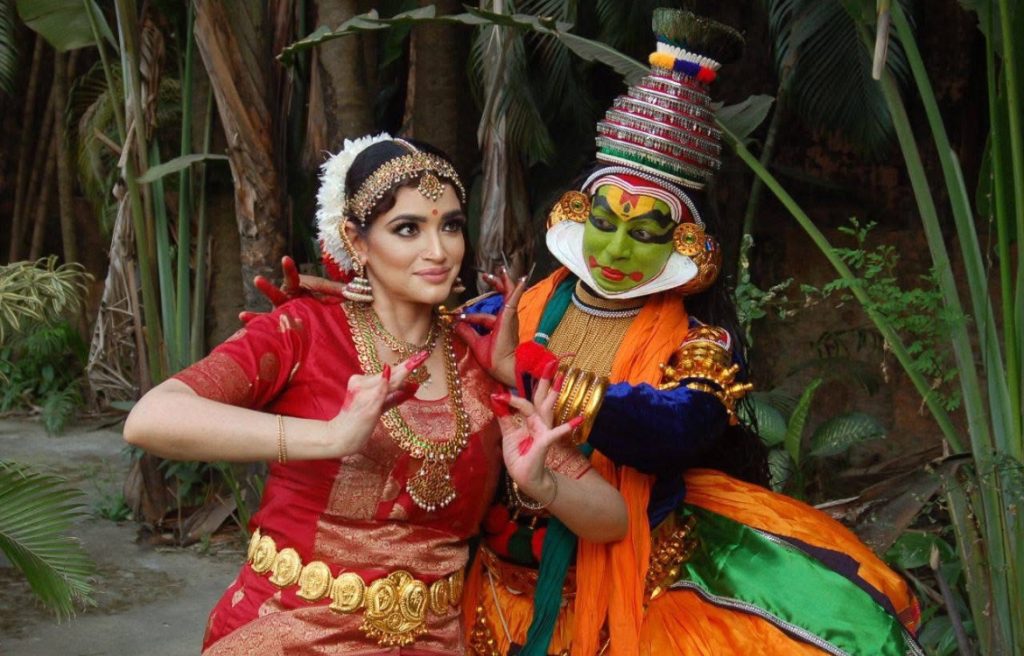
From Kerala emerges Kathakali, a highly stylised dance-drama developed in the 17th century under royal patronage and influenced by earlier temple and martial traditions. Masters like Kalamandalam Krishnan Nair and Ramankutty Nair elevated the form to international prominence. Kathakali’s connection to nature is elemental and dramatic. Its exaggerated gestures and facial expressions evoke animals, storms, forests, and cosmic conflict. The green faces of heroes, the fiery reds of antagonists, and the towering costumes echo Kerala’s lush vegetation and intense natural contrasts. The body becomes landscape, embodying the forces of creation and destruction found in epics and in nature itself.
Odissi, from Odisha, draws inspiration from temple sculptures, particularly those of Konark and Puri. Revived in the 20th century by gurus such as Kelucharan Mohapatra and Pankaj Charan Das, and popularised by dancers like Sanjukta Panigrahi and Sonal Mansingh, Odissi is defined by its lyrical tribhangi posture. Its curved movements resemble flowing rivers, bending creepers, and ocean waves along Odisha’s coastline. The dance breathes through softness and grace, mirroring water’s ability to be both gentle and powerful. Odissi’s devotional themes further reinforce this connection, where nature becomes a metaphor for divine love.
The northeastern tradition of Manipuri, originating in Manipur, embodies serenity and restraint. Developed within Vaishnavite devotional traditions, and preserved by exponents such as the Jhaveri Sisters and Guru Bipin Singh, Manipuri avoids sharp foot strikes, allowing movements to glide softly across space. Its circular patterns resemble ripples in water, swaying bamboo, and drifting clouds. The dance reflects the ecological harmony of the region, where movement feels continuous rather than segmented, echoing nature’s quiet rhythms.
Sattriya, from Assam, founded by the saint-scholar Srimanta Sankardev, developed within Vaishnavite monasteries known as sattras. Artists like Indira P. P. Bora and Jatin Goswami brought it into contemporary performance spaces. Sattriya’s movements often evoke pastoral imagery — the playfulness of Krishna among forests and rivers, the serenity of monastic life, and the balance between vigour and stillness. The dance reflects Assam’s riverine landscape, particularly the Brahmaputra’s dual nature: calm yet powerful, meditative yet dynamic.
Kuchipudi, from Andhra Pradesh, traces its roots to the village of the same name and was systematised by Siddhendra Yogi. Legends such as Vempati Chinna Satyam and Raja-Radha Reddy shaped its modern identity. Kuchipudi’s buoyant leaps and expressive storytelling resemble flowing streams and the energetic vitality of agrarian life. Its theatricality carries the spontaneity of folk celebration, echoing harvest cycles and communal joy.
Mohiniyattam, also from Kerala, refined under the patronage of Maharaja Swathi Thirunal and revived by artists like Kanak Rele and Bharati Shivaji, is characterised by gentle swaying movements. Often described as the dance of enchantment, its motion resembles palm trees moving in coastal winds and the slow flow of Kerala’s backwaters. Softness, grace, and continuity define its aesthetic, mirroring nature’s quieter expressions.
Across these traditions, nature is not merely inspiration but philosophy. The dancer imitates animals, seasons, rivers, and celestial rhythms, reflecting an Indian worldview where art, environment, and spirituality remain inseparable. The body becomes landscape; movement becomes ecology — an idea deeply embedded in Bharata Muni’s vision of performance as a reflection of cosmic order.
Yet classical dance in India has never remained static. Post-independence artists reinterpreted mythology, introduced contemporary themes, and carried these forms onto global stages. The challenge has always been balance — preserving grammar while allowing evolution. Classical dance survives because it adapts without forgetting.
It is within this continuum that Bollywood emerges as an unexpected yet powerful inheritor. Often dismissed as spectacle, Hindi cinema dance has absorbed elements from classical forms — Kathak spins, Bharatanatyam gestures, folk vitality, and Western influences — creating a hybrid vocabulary that travels effortlessly across borders. Many of India’s finest film choreographers and performers have classical training at their core, translating complex traditions into accessible emotion.
Bollywood’s genius lies in its reach. Where classical dance requires cultural literacy to decode symbolism, cinema communicates instantly. A gesture becomes universal; rhythm becomes exportable. Song and dance sequences carry fragments of India’s aesthetic heritage to audiences far removed from temple or theatre.
In this fusion lies India’s modern soft power. Classical dance preserves depth and continuity, while Bollywood ensures visibility and reinvention. Together they form a continuum rather than a contrast — tradition feeding popular culture, and popular culture sustaining tradition’s relevance.
India’s dances endure because they understand something elemental: movement is memory, and memory is alive. Each step carries the echo of earth, water, wind, and story. And as Bollywood carries these rhythms onto the global stage, India dances not between past and present, but through them — a civilisation moving forward while remaining rooted in the timeless choreography of nature itself.
[ Sohini Roychowdhury, Indian dancer, choreographer, visionary, philosopher and professor of Natyashastra, is the founder of Sohinimoksha World Dance & Communications and Sohinimoksha Artes de La India in Madrid, Kolkata and Berlin. ]
Get real time update about this post category directly on your device, subscribe now.

